Tree Basics
A Tree data structure is a hierarchical collection of nodes. Each Tree node stores a data value and has pointers to pointing to its child nodes.
•	A single node at the topmost level is called the root node.
•	Nodes that have children are called parent nodes.
•	Nodes at lower levels (not lowest levels) are called branch nodes.
•	Nodes at lowest level are called leaf nodes and do not have child nodes.
•	Parent or child nodes of a node are called its neighbors.
•	The number of children of a tree is known as its Degree.
•	The max Degree of nodes in the Tree is known as the Degree of the Tree.
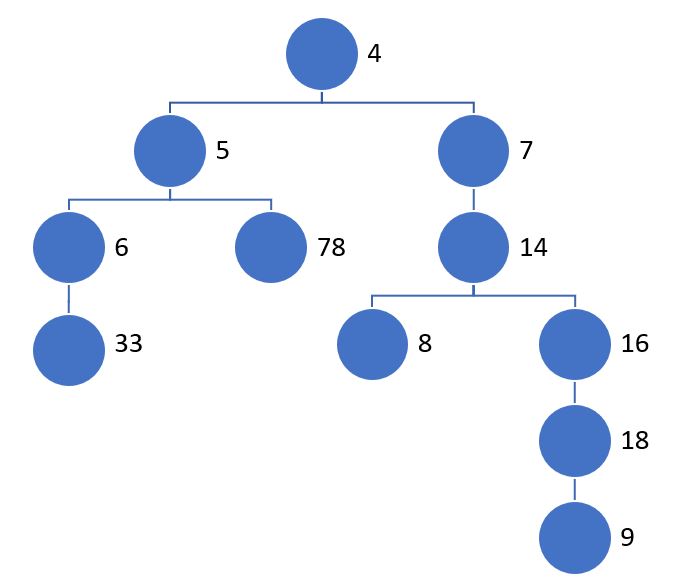
In the below diagram:
•	Node with data value 4 is the root node.
•	Nodes with data value 4, 5,7, 6, 14, 16, 18 are parent nodes and branch nodes.
•	Nodes with data values 33, 78, 8, 9 are leaf nodes.
Types of Trees
•	N-ary tree: Each node of N-ary Tree may have 0..n nodes.
•	Ternary tree: Each node of Ternary Tree may have 0..3 nodes.
•	Binary tree: Each node of Binary Tree may have 0..2 nodes.
•	Binary Search Tree: a Binary tree that’s nodes are sorted as per binary sort algorithm.
•	AVL tree :a self balancing binary tree.
•	Red-Black tree: a self balancing binary search tree with coloring rules.
•	B-Tree: A B-Tree of order n is node with maximum n children per parent.
Use cases for Trees
| Algorithms requiring efficient sorting. |
| Algorithms requiring efficient searching. |
| To represent hierarchies, hierarchical data. |
| Used in databases for quick data access. |
| Used in compilers, Interpreters to parse expressions. |
Time Complexity of Binary Search Tree operations
Following table shows time complexity metrics for BST Operations:
| Operation | Complexity |
|---|---|
| Add operation. | O(log n) |
| Remove/Delete operation. | O(log n) |
| Search operation. | O(log n) |
| Traverse | O(n) |
Tree in Java JDK API.
Java API does not provide a Binary Tree class, which provides the required Binary Tree behavior. Below code challenges provide a custom Binary Tree implementation.
| About Us | Privacy Policy | Contact us |