CC-3 : Implement Breadth First Traversal of Binary Tree using recursion.
Description:
Implement and test a Breadth First Traversal of Binary Tree using recursion.
Test cases and expected outputs:
| Input Parameters | Expected outputs |
|---|---|
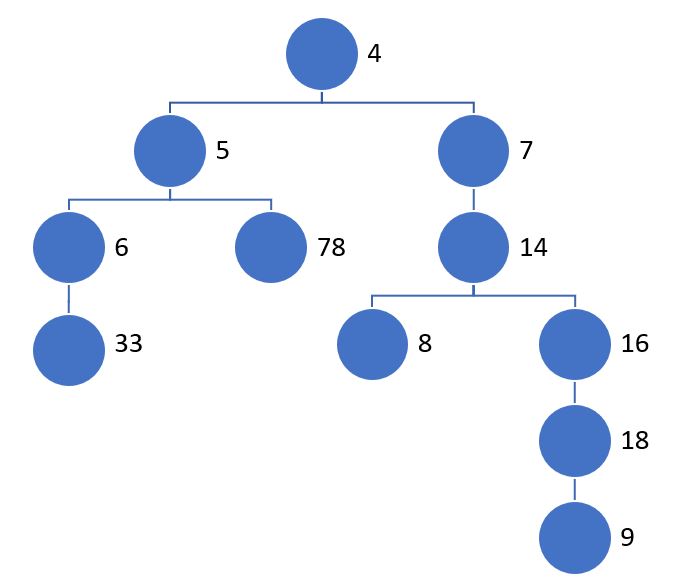
|
Bfs traversal : 4,5,7,6,78,14,33,8,16,18,9 |
Pseudocode:
| Define an ArrayList to hold the nodes traversed while doing Breadth First traversal. |
Method bfs():
| Call method maxLevel() to find the maximum depth of the Binary Tree. |
| Iterate through each level of the Binary Tree using for loop
Call method bfsLevelwise with root node of Binary tree and current level
|
Method bfsLevelwise(root,lvl):
| If lvl=1, add data of root node to Breadth First traversal arraylist. |
| Else:
bfsLevelwise(root.getLeftChild(), lvl-1).
bfsLevelwise(root.getRightChild(), lvl-1).
|
Method maxLevel(root)::
| Set leftLevel=maxLevel(root.getLeftChild()). |
| Set rtLevel=maxLevel(root.getRightChild()). |
| If (leftLevel > rtLevel) return leftLevel+1. |
| If (rtLevel > leftLevel) return rtLevel+1. |
Code:
public class BinTreeBfsRecursive {

private ArrayList<Integer> bfsTraversal=new ArrayList<Integer>();
public ArrayList<Integer> getBfs() {
	return bfsTraversal;
}
public void setBfs(ArrayList<Integer> bfsTraversal) {
	this.bfsTraversal = bfsTraversal;
}

public void bfs(BinTreeNode root) {
	int maxlevel= maxLevel(root);
	for (int lvl=1; lvl<=maxlevel; lvl++) {
		bfsLevelwise(root, lvl);
	}
}

public void bfsLevelwise(BinTreeNode root, int lvl) {
	if (root==null) {return;}
	if (lvl==1) {
		bfsTraversal.add(root.getNodeData());
	}else {
		bfsLevelwise(root.getLeftChild(), lvl-1);
		bfsLevelwise(root.getRightChild(), lvl-1);
	}
}

public int maxLevel(BinTreeNode root) {
	if (root==null) {return 0;}
	else {
		int leftLevel=maxLevel(root.getLeftChild());
		int rtLevel=maxLevel(root.getRightChild());
		if(leftLevel > rtLevel) {
			return leftLevel+1;
		}else {
			return rtLevel+1;
		}
	}
}
}
Click here to download and run code and test cases !
| About Us | Privacy Policy | Contact us |